Why hard water matters before you shop
Hard water leaves its mark in San Diego homes long before a softener ever shows up. White spots form on shower doors, soap stops lathering in the sink, and appliances run harder through the year. Each sign points to the same source, calcium and magnesium pulled from the local supply.
The right softener is the one matched to the actual hardness at the tap and to how much indoor water the home uses. A big tank with a flashy grain rating does not guarantee that fit on its own. Match the unit to the address, not the marketing.
Pull the number from your provider, not the county
San Diego County draws from many utilities, and the blend changes through the year. A countywide estimate can mislead a sizing call. Open a recent water bill, find the serving utility, and read that utility’s current water quality report.
The City of San Diego reports that its own supply typically averages about 16 grains per gallon. The same source lists a range of 16 to 18 grains per gallon, depending on demand and where in the city the sample is drawn. That range helps City customers set expectations. It does not replace an address-specific reading and should not carry over to other providers or wells.
A free in-home test supplies a real number for sizing. It also flags the limits of that test. Hardness alone is not a full panel for every concern. For lead, nitrate, arsenic, PFAS, or bacteria, name the concern first. Then use the utility report or a certified laboratory.
You can also try our water hardness calculator for a quick reference point before scheduling a test.
Run the basic sizing math
The sizing math rides on a simple formula:
Hardness in grains per gallon multiplied by gallons of treated water per day equals the daily load of hardness to remove.
Pull recent bills and walk the household through actual routines. Skip outdoor uses that bypass the softener when the plumbing allows. Talk through peak demand, including back-to-back showers and large fixtures, with the installer. Daily volume and peak demand sit on opposite ends of the sizing conversation, and both deserve a number.
A family-of-four label on a box rarely fits two real four-person homes. Two systems with the same advertised capacity can produce different working capacity once you set the salt dose. Our guide on sizing a softener walks through the steps in more detail.
Ask the provider to put these in writing before any commitment:
- Source and value of the hardness reading used
- Daily gallons after excluding outdoor and other unbypassed uses
- Exact model and its working capacity at the proposed salt dose
- Regeneration trigger and the numbers behind it
- Service flow used to size for peak demand
Stepping up in size does not automatically help. EPA guidance flags oversized units as water-wasters. The fit should match the home, not the showroom floor.
Choose demand-based regeneration
An ion-exchange softener swaps calcium and magnesium for sodium as water moves through resin. The resin recharges with brine on a regular cycle, and that cycle consumes salt, water, and drain capacity.
EPA points to demand-initiated regeneration in place of a clock-driven timer. A demand-driven valve reads a meter or a hardness sensor and fires only when the resin is loaded. That shifts the conversation from label size to control logic.
For the specific model, line up these items:
- NSF/ANSI 44 certification for a residential ion-exchange softener
- Working capacity at the planned settings
- Gallons of water used per recharge
- Salt dose per recharge
- Inclusion of demand-initiated regeneration and how it is set up
- Manufacturer guidance for install, bypass, cleaning, and service
NSF/ANSI 44 is useful but narrow. It does not rank brands and does not show that the same unit cuts chlorine, PFAS, lead, or any other contaminant on its own. Any added reduction claim must come with exact-model paperwork.
Decide what outcome you actually want
A salt-based ion-exchange softener strips out hardness minerals and delivers soft water. A salt-free conditioner keeps calcium and magnesium in the line and works on keeping scale from forming. Those two paths lead to different end results.
When hardness removal is the goal and the property can support a brine line and a drain, a softener is the right call. When the goal is scale control without salt or regeneration discharge, a salt-free conditioner can fit, but only with evidence the exact model holds up at the home’s conditions. A “salt-free softener” tag is not the same as proof of soft water.
Our water softener versus salt-free conditioner guide walks through the tradeoffs in more depth.
Walk the property with the installer
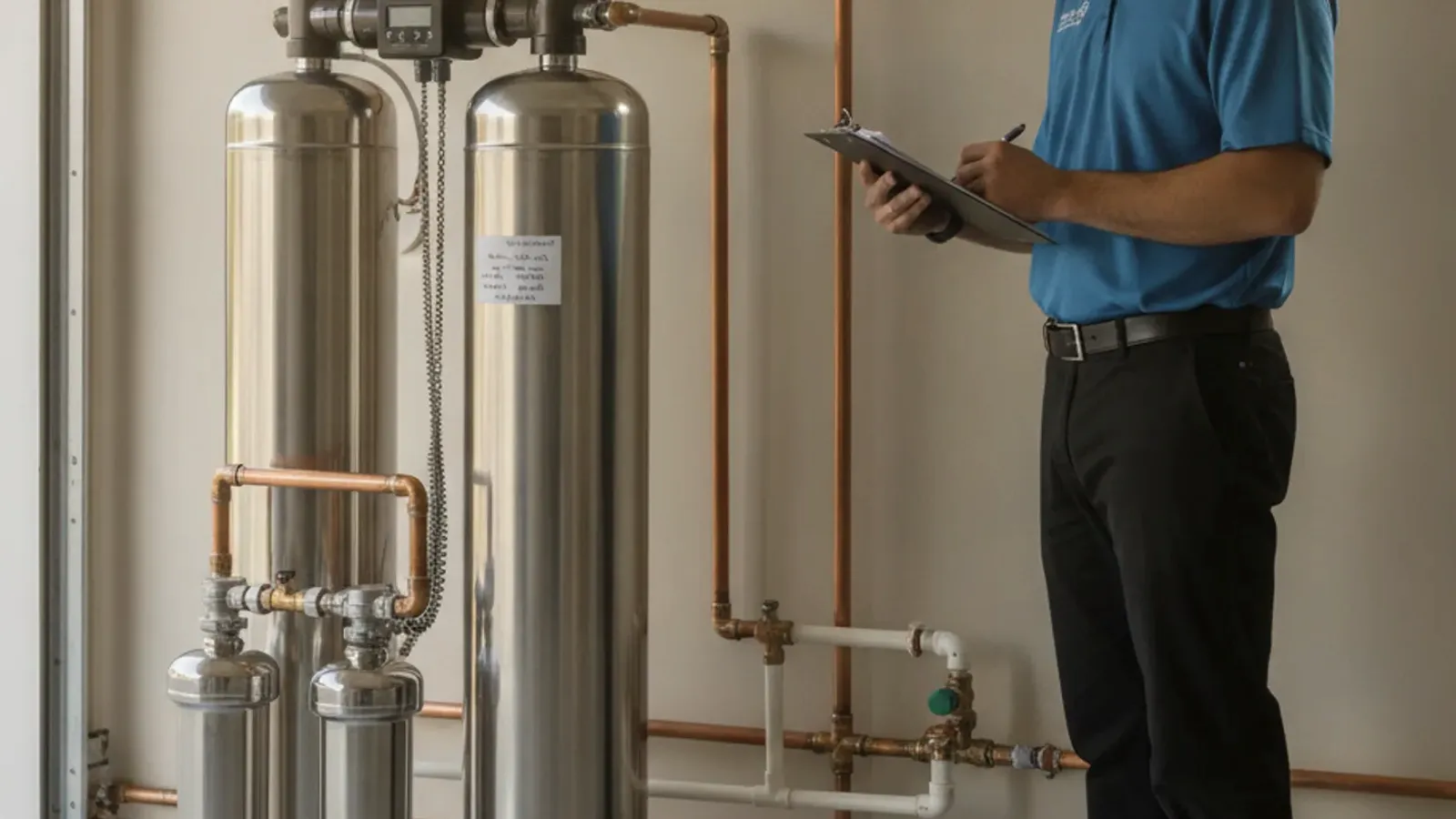
A unit can size correctly on paper and still miss the room. The installer should walk the main shutoff, the available square footage, the drain path, the power outlet, the bypass location, the irrigation branch, and the service clearances. Each item can rule out a unit before a wrench comes out.
Rules on salt-based softeners shift by authority and by property. Skip the single countywide rule of thumb. Confirm the current permit and discharge terms for the address with the local authority and with the licensed pro who will do the work. The City of San Diego currently lists qualifying water-softener installs as work that can use its Simple No-Plan plumbing permit, within the City and property rules in play.
Compare written quotes line by line
A useful proposal lines up the same facts across bidders. Ask each provider to spell out these items:
- Manufacturer and exact model number
- Stated treatment goal plus what the unit will not address
- Hardness and daily-use figures used to size
- Working capacity, peak flow, and regeneration logic
- Third-party certifications and the specific reduction claims they cover
- Line-item costs for equipment, labor, permit, drain, electrical, startup, and haul-away
- Salt, water, filter, media, and service schedule
- Warranty terms, exclusions, and service provider
- Post-install measurements that confirm the unit is doing its job
Pass on proposals that lean on an unverified tank-material label, a generic lifetime promise, or any blanket claim that one unit fixes every water concern. Product documentation and certification paperwork beat any marketing line.
Plan for upkeep before the install
Once installed, a softener wants ongoing care. Stick to the model’s salt level, resin and brine tank cleaning, bypass use, and regeneration settings. Look over the connections, valves, and drain line on a regular cadence. Water moving to the drain when the unit is idle often points to a fault.
Before the install, ask who handles service, what the homeowner covers, and what parts or supplies run over a year. Those answers belong on the front end, not in a surprise on the first service visit.
Talk to a local professional
Clear Water Pros SD is an information and referral site. We arrange free in-home water tests and connect homeowners with separately licensed water filtration pros. The homeowner picks the pro and pays that pro directly.
Schedule a free in-home water test or call (858) 400-4647. Bring a recent bill, the current utility report, and any paperwork on existing equipment. The pro can then walk through the sizing math and put the quote in writing.
Frequently asked questions
How do I size a softener for a San Diego home?
Household size alone does not answer it. The size of the unit depends on the actual hardness reading, the gallons that will run through the softener, peak flow at busy hours, and the model’s working capacity at the planned salt dose.
Does a bigger tank work better?
Capacity alone does not tell the full story. A small working capacity means frequent regeneration and possible hardness breakthrough. An oversized unit wastes water and inflates the upfront cost. Ask the pro for the sizing numbers on paper.
Salt-based softener or salt-free conditioner?
The right pick follows from the goal. Ion exchange pulls calcium and magnesium out of the supply. A salt-free conditioner leaves those ions in the line and should be judged on its specific scale-reduction claim. Site rules, maintenance demands, drainage, and water use can also tip the choice.
Will an NSF-certified softener handle every contaminant?
No. NSF/ANSI 44 applies to residential ion-exchange softeners and the specific claims on its scope. It does not mean the model addresses every contaminant. Confirm any extra reduction claim with paperwork tied to the exact model.
What should a free in-home water test include?
For sizing, the test should give a hardness reading at the tap and the test method behind it. It is not a full contaminant panel by default. Pull the serving utility’s current report and send other concerns to a certified lab.
When to bring in a licensed pro
When the math is done and the property has been walked, a separately licensed water-treatment pro can size, install, or service the unit to local code. That step protects the warranty and keeps the install clean. Call (858) 400-4647 and Clear Water Pros SD will connect you with an independent local water-treatment professional.