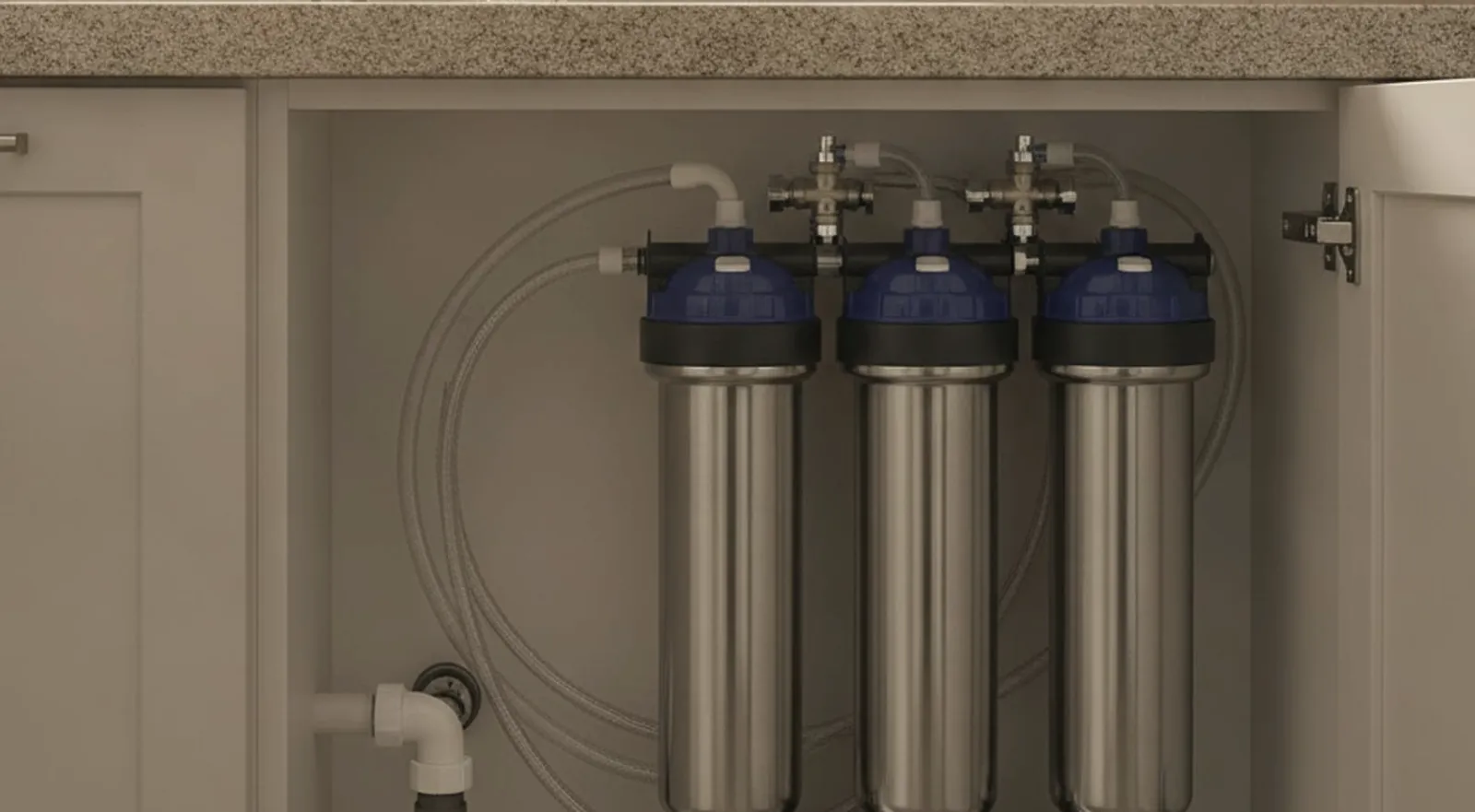
Pricing for point-of-use filtration in 2026
San Diego County residents often ask about the expense of purified drinking water. A professionally installed under-sink reverse osmosis unit typically costs between $300 and $900 in 2026. The final price depends on filtration stages, membrane quality, and existing plumbing. Whole-home setups represent a completely different investment level. Those larger systems generally range from $3,000 to $8,000 or more.
Homeowners should also budget for ongoing upkeep. Annual maintenance for pre-filters and post-filters usually falls between $60 and $150. The main membrane needs replacement every two to five years. That specific part costs anywhere from $80 to $200.
Clear Water Pros SD is a referral network serving San Diego County, California. It connects homeowners with independent, separately licensed local water-treatment professionals. Those professionals perform all installations and testing. Clear Water Pros SD performs no work itself.
What determines your total installation expense
Most households in the county spend between $300 and $900 for a complete under-sink setup. That figure includes the filtration unit, all filters, the membrane, a dedicated tap, and standard labor. Budget-friendly options at the lower end use basic membranes with fewer purification stages. Mid-tier models costing $500 to $750 feature NSF/ANSI 58 certified membranes. These middle-tier units deliver better flow and longer membrane durability.
Here is a breakdown of typical pricing tiers for 2026:
| Unit category | Installed price (2026) | Purification stages | Membrane type |
|---|---|---|---|
| Basic | $300 to $450 | 3 to 4 | Standard, shorter lifespan |
| Mid-tier | $500 to $750 | 4 to 5 | NSF/ANSI 58 certified |
| High-end | $750 to $900+ | 5 to 6 | High-rejection, extended life |
| Whole-home | $3,000 to $8,000+ | Varies | Commercial-grade |
Labor adds roughly $100 to $250 if your cabinet space is simple to access. Older houses with unusual pipes, rusted shutoff valves, or tight cabinets might increase that labor figure. You can explore reverse osmosis drinking water options to understand what fits your home.
Components included in your purchase
The quoted price covers several integrated parts working together behind your sink.
Purification stages form the core of any unit. A standard four-stage or five-stage design features a sediment pre-filter, one or two carbon blocks, the main membrane, and a final polishing filter. Adding stages broadens contaminant removal and improves overall taste.
The semi-permeable membrane handles the heaviest lifting. This barrier rejects dissolved solids, nitrates, PFAS, fluoride, arsenic, and heavy metals. Quality varies widely across price points. Always look for NSF/ANSI 58 certification on this component.
The pressure tank stores purified water until you turn the tap. Tank construction matters for long-term water quality. Cheaper units often rely on plastic-lined containers. Licensed professionals frequently recommend stainless steel tanks because water sits inside them between uses.
The dedicated faucet provides a separate tap strictly for drinking water. Basic models come in standard chrome. Upgraded finishes like brushed nickel or matte black help match existing kitchen hardware.
Professional labor covers tying into the cold water line, routing the drain tube, securing the tank, and verifying flow rates. A proper setup by a licensed contractor takes one to two hours.
Yearly upkeep and filter replacements
Ongoing expenses are surprisingly manageable for most households. Your primary recurring costs involve swapping out spent cartridges and eventually replacing the membrane.
| Component | Replacement schedule | Typical expense |
|---|---|---|
| Sediment pre-filter | Every 6 to 12 months | $10 to $25 |
| Carbon block(s) | Every 6 to 12 months | $15 to $35 each |
| Polishing post-filter | Every 12 months | $15 to $30 |
| Main RO membrane | Every 2 to 5 years | $80 to $200 |
| Yearly total (filters only) | Ongoing | $60 to $120 |
Local water tends to run harder and higher in total dissolved solids than many other regions. This chemistry can shorten cartridge lifespans slightly. A noticeable drop in flow from your drinking tap usually signals a clogged pre-filter. Read more about reverse osmosis filter replacement in San Diego to plan your schedule.
Annual upkeep for a typical household ranges from $70 to $150. Compare that to buying bottled water daily. A family consuming two liters per day spends roughly $600 to $900 annually on bottles. Point-of-use filtration produces clean water for just pennies per gallon.
Why this technology suits local tap water
For most county residents, the investment makes practical sense. The municipal supply arrives from the Colorado River and the State Water Project. Both sources travel vast distances through hard rock formations and agricultural zones. That journey leaves the water with relatively high total dissolved solids, elevated hardness, and measurable nitrates.
The local utility relies on chloramine rather than free chlorine for disinfection. Chloramine resists standard carbon filtration and leaves a distinct taste. A properly configured system reduces TDS, hardness, chloramine, nitrates, PFAS, fluoride, arsenic, and lead. Quality membranes lower TDS by 85 to 98%. Learn how chloramine differs from chlorine in San Diego water to understand why membrane filtration helps.
This approach makes sense if you worry about PFAS or nitrates. It also suits homes with children or elderly residents who drink tap water daily. If you currently buy bottled water constantly, a permanent system pays for itself quickly. You might skip it if you rent and cannot modify cabinetry. A simple pitcher might suffice if you only want minor taste improvements. Check our guide comparing reverse osmosis versus a filter pitcher for details.
Remember that these units treat only drinking and cooking water. They do not soften your entire home supply. If scale buildup plagues your showerheads or appliances, you need a separate solution. Consider exploring hard water solutions for whole-home mineral issues.
Comparing single-tap and whole-home configurations
Under-sink and whole-home setups serve entirely different purposes at vastly different prices.
A single-tap unit costing $300 to $900 treats only one dedicated faucet. It targets drinking and cooking needs specifically. These smaller systems produce three to five gallons hourly and store a few gallons in a compact tank. This remains the right choice for most families wanting cleaner drinking water.
A whole-home setup starting at $3,000 and exceeding $8,000 purifies every drop entering the house. It demands a massive membrane array, a large storage tank holding 100 to 300 gallons, and a re-pressurization pump. Installation is far more complex. While highly effective for severe water quality problems, most residents simply do not need this for drinking water alone. Browse whole-house versus under-sink water filters to weigh your options.
The math favors single-tap units for most households. They handle actual consumption needs while costing a fraction of whole-home alternatives. They typically pay for themselves against bottled water purchases within two to three years. If fixture scale bothers you, a water softener offers a more cost-effective route. Look into under-sink water filtration to review all available point-of-use choices.
Targeting specific contaminants in the county
Membrane filtration aligns perfectly with the unique chemistry of local tap water. Imported supplies carry high total dissolved solids from their distant sources. Standard carbon blocks improve flavor but fail to reduce those dissolved minerals. Semi-permeable barriers reject them at the molecular level.
Because the utility uses chloramine instead of free chlorine, you need specific pre-filtration. Standard carbon struggles against chloramine. A catalytic carbon pre-filter neutralizes it before water ever reaches the main membrane. We discuss this further in our article on activated carbon versus catalytic carbon for chloramine.
PFAS compounds have appeared in various California supplies. Membranes carrying NSF/ANSI 58 Protocol P473 certification verify the reduction of PFOA and PFOS. Not every unit holds this specific credential. Always confirm before purchasing. Our guide on removing PFAS from local water explains what to look for.
Nitrates, fluoride, arsenic, and dissolved lead respond well to quality membranes. If your property has older pipes, reducing lead at the tap protects your household directly. An independent professional can evaluate your specific plumbing during an assessment. Request a free in-home water test to learn your exact numbers before committing.
Professionals in the referral network cover the entire county using a straightforward process. They test first, size the equipment based on your actual water, and install certified components. Many also offer remineralization options for households preferring balanced water after treatment. Whether you live in Carlsbad or Chula Vista, local experts handle the work.
Frequently asked questions
How many years will my unit last?
A well-maintained under-sink system operates reliably for 10 to 15 years. The membrane requires swapping every two to five years. Pre-filters and post-filters need annual attention. Housings, tubing, and faucets often survive multiple membrane cycles.
Does this process waste water?
Traditional designs flush rejected contaminants down the drain via a concentrate stream. Older models operate at roughly a 3-to-1 waste ratio. Modern high-efficiency membranes improve that ratio to 1.5-to-1 or better. For most households, the drained volume remains small compared to total daily use.
Should I attempt a DIY setup?
Retailers sell kits designed for handy homeowners. However, improper supply connections or loose drain clamps can cause slow leaks. Water damage inside cabinets gets expensive quickly. Professional installation by a licensed contractor typically costs $100 to $250. That fee includes leak verification and flow testing.
Will the system strip healthy minerals?
Semi-permeable membranes remove virtually all dissolved minerals, including calcium and magnesium. Some homeowners prefer adding a remineralization cartridge as a final stage. This optional step restores trace minerals for taste and slightly raises the pH.
How do I know when filters need changing?
A noticeable drop in flow from your dedicated tap is the clearest indicator. The storage tank might take longer to fill up. Some modern units include electronic change indicators. Without one, set a calendar reminder for annual swaps and check flow every six months.
Planning your next steps
Anytime you notice persistent taste issues or worry about specific contaminants, a separately licensed professional should evaluate your water. They can determine if membrane filtration matches your household needs. Call (858) 400-4647 and Clear Water Pros SD will connect you with an independent local water-treatment professional.