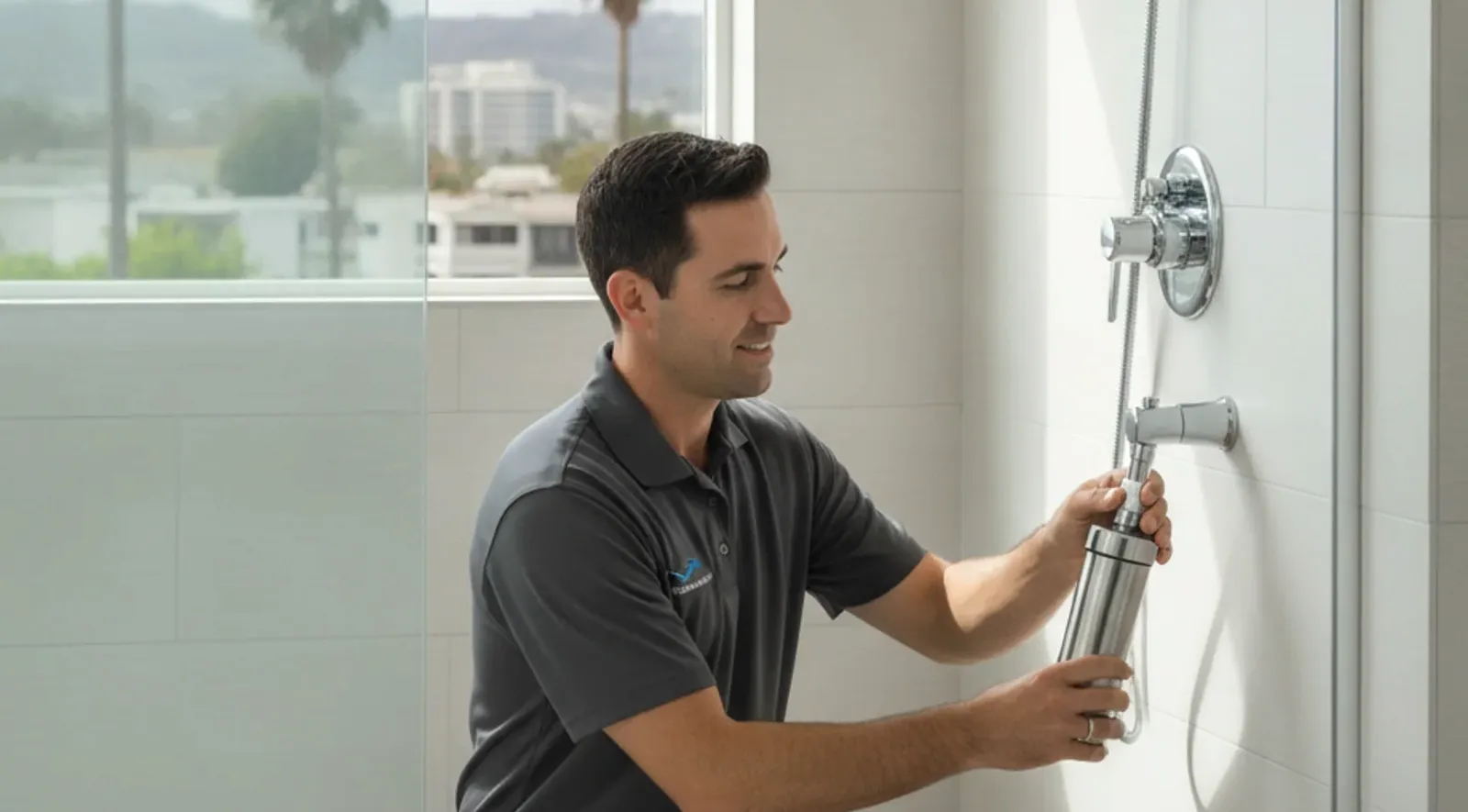
Many homeowners buy a cartridge hoping it will act as a hard water filter for shower heads. That expectation leads to disappointment every single time. Shower attachments target chlorine, not dissolved rock. Calcium and magnesium cause the stiffness you feel on your skin. Those two minerals slip right through any small shower device. Only specific technologies can pull hardness out of your tap supply. A tiny attachment hanging from your plumbing simply lacks the capacity.
San Diego County receives municipal water loaded with these minerals. The City of San Diego reports an average hardness near 16 grains per gallon. Depending on your neighborhood and seasonal demand, that number ranges from 16 to 18. The U.S. Geological Survey classifies anything above 10.5 gpg as very hard. Most of our local supply travels from the Colorado River and Northern California. Both sources gather heavy mineral loads before reaching county taps.
What those small shower devices actually catch
The media inside a typical shower cartridge targets disinfectants. Manufacturers usually pack one of three materials into the housing. You will find KDF-55, which is a copper-zinc alloy. Others rely on granular activated carbon or vitamin C cartridges. All three operate through chemical reactions or adsorption. They bond specifically with chlorine compounds flowing past them.
None of these materials react with calcium or magnesium ions. Hardness minerals stay dissolved because they lack the chemical reactivity needed here. Chloramine presents an even tougher challenge for these small filters. Local utilities prefer chloramine because it stays stable longer than plain chlorine. That exact stability helps it resist KDF-55 and carbon media. Water typically touches the filter media for roughly one second during a shower. That brief window strips away free chlorine fairly well. It does not give chloramine enough time to break down fully. It certainly fails to alter dissolved mineral content.
Why softening requires more than a showerhead attachment
True softening demands a process called ion exchange. This method trades calcium and magnesium ions for sodium or potassium ones. That swap only happens inside a dedicated ion exchange resin bed. Full water softeners contain large tanks packed with this specialized resin. A shower cartridge holds its media inside a container the size of a coffee mug. There is no physical space for the volume of resin required. Furthermore, resin beds need regular regeneration cycles to keep working. Small shower attachments have no mechanism to flush and recharge their media.
Contact time creates another insurmountable barrier. Softening resin needs sustained exposure to finish the ion swap. Water rushing through a showerhead passes the media in about a second. That speed works fine for grabbing chlorine molecules. It gives hardness minerals zero chance to bind to anything. Reverse osmosis offers another path to mineral removal. That technology forces water through a membrane under pressure at low flow. A showerhead demands high flow rates and open space. Those requirements directly contradict how reverse osmosis functions.
Deciding if a shower cartridge makes sense locally
A shower attachment makes sense if chlorine smell bothers you most. It also helps if chemical exposure causes your dry skin. It offers nothing if white crust builds up on your fixtures. Stiff hair after washing points to minerals, not disinfectants. Installing a shower cartridge here removes one irritant while ignoring the larger one. Homeowners expecting less scale on glass doors usually see results within a week. The disappointment arrives quickly because the offending minerals remain in every drop.
Neighborhood variations matter when evaluating your options. East County areas like El Cajon often run toward the higher end of local hardness ranges. A shower cartridge alone accomplishes very little in those specific zones. You can review hard water solutions to explore broader treatment methods. Checking your specific area helps set realistic expectations before buying anything. Read more about is San Diego water hard for detailed numbers by neighborhood. Visit our page covering water filtration service in El Cajon for localized details.
The real approach to treating minerals at the fixture
Addressing hardness requires treating water before it reaches any fixture. A whole-house system handles this through ion exchange at the main line. That prevents calcium and magnesium from entering your plumbing entirely. Treating the entire supply stops scale buildup on shower glass. It allows soap to lather properly instead of forming sticky curds. Your skin and hair stop reacting to constant mineral accumulation. A shower cartridge treats exactly one tap in the house. A central system protects every faucet, appliance, and pipe simultaneously.
Some households pair a central softener with a separate carbon stage. A softener removes hardness but leaves chlorine untouched. Adding a carbon filter addresses both taste and chemical odor together. That combination solves the problems a shower cartridge attempts alone. Mineral buildup affects much more than just bathroom surfaces. Learn how minerals impact your scalp by reading hard water and hair loss. If irritated skin troubles your family, check does a water softener help eczema for relevant information.
Matching the right equipment to your symptoms
Picking the correct equipment starts with identifying your primary complaint. Buy a shower cartridge if chlorine odor is your only issue. Skip it if you constantly scrub white residue off your tiles. Stiff hair and poor soap lathering always indicate a hardness problem. Combining both approaches works when you want total chlorine reduction and mineral removal. That usually means installing a central softener alongside a small inline carbon stage.
| Feature | Shower cartridge | Central softener |
|---|---|---|
| Targets chlorine | Yes | No |
| Reduces chloramine | Partially, struggles at high flow | No |
| Extracts calcium and magnesium | No | Yes |
| Prevents scale formation | No | Yes |
| Typical price range | $20-$80 | $1,500-$5,500 installed |
| Setup method | Screws onto existing plumbing | Professional whole-house install |
Guessing your hardness level from county averages rarely works perfectly. Scheduling a free in-home water test measures your actual grains per gallon. Clear Water Pros SD connects homeowners across the county with vetted local water treatment pros. These independent professionals size the fix based on your real numbers. Review water softener cost in San Diego for a full pricing breakdown. If you are weighing traditional softeners against other conditioners, read water softener vs salt-free conditioner to understand the tradeoffs. Exploring whole-house water filtration options might also fit your goals.
Frequently asked questions
Can a shower cartridge soften my tap supply?
No. Those devices use carbon or KDF-55 to grab chlorine. They cannot extract dissolved calcium or magnesium from your plumbing. True softening requires ion exchange resin found in central systems.
Which shower attachment works for hard water?
None of them address hardness minerals directly. The top models reduce chlorine and chemical odors effectively. Fixing actual mineral buildup requires professional whole-house equipment.
Will a shower cartridge prevent scale on my glass?
It will not. Scale forms when calcium and magnesium dry on surfaces. Since shower attachments leave those minerals intact, the spotting continues. Only ion exchange stops that specific deposit from forming.
Does a shower cartridge help dry skin locally?
It helps if chlorine exposure causes your irritation. Chlorine strips natural oils from your body during every wash. It cannot fix dryness caused by mineral accumulation given our local hardness levels.
Should I add a shower cartridge to my softener?
Only if chlorine taste or smell still bothers your household. Softeners handle minerals but ignore disinfectants completely. Pairing a small carbon stage with your central system covers both issues.
Getting expert eyes on your plumbing
Visible scale buildup or persistent skin irritation warrants professional attention. A separately licensed local expert should evaluate your home’s plumbing and water quality. They can recommend the proper equipment sized specifically for your property. Call (858) 400-4647 and Clear Water Pros SD will connect you with an independent local water-treatment professional.