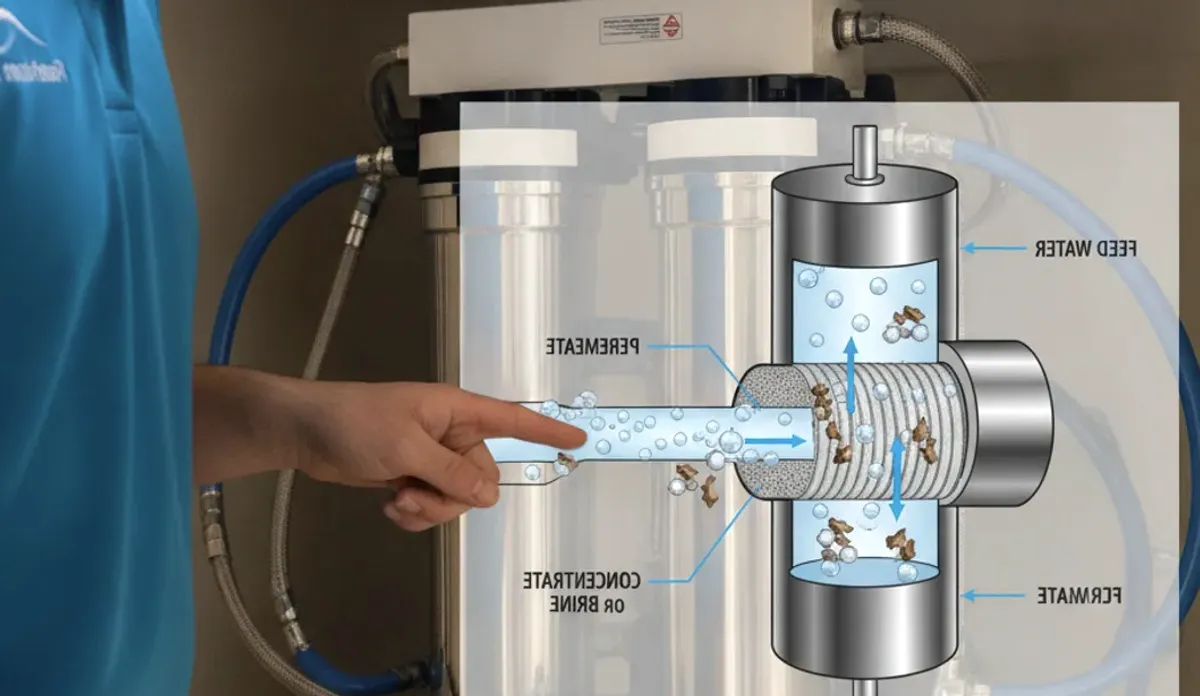
Understanding natural osmotic movement
Water naturally travels across a selective barrier toward higher solute concentrations. That basic physical tendency drives the process called osmosis. The force behind this movement is known as osmotic pressure. Real separation depends on membrane chemistry, temperature, and incoming water quality. It is not simply about blocking particles by size.
Applying pressure to reverse the flow
Reverse osmosis uses applied pressure to push water the opposite way. Part of the supply crosses the membrane as treated drinking water. The remainder leaves as a concentrated reject stream. An under-sink filtration setup might use line pressure or a booster pump. Higher salinity raises the required operating pressure. Household units differ greatly from equipment built for seawater. Always check the specific system documentation for limits.
Checking certified performance claims
NSF/ANSI 58 governs point of use reverse osmosis equipment. This standard requires specific TDS reduction and allows optional contaminant claims. Certification for one substance does not guarantee removal of another. Homeowners should review several details before selecting a model:
- The exact unit name and its documented reduction claims.
- Required feed pressure and water quality limits.
- Rated flow, recovery, and efficiency under test conditions.
- Pretreatment needs and installation specifications.
- Manufacturer instructions for filter and membrane replacement.
- Cost and availability of future replacement elements.
No single technology eliminates every possible contaminant. Match the certified claim to your actual water concern. A free in home water test helps identify specific issues first.
Why reject water is produced
The reject stream carries concentrated dissolved material away from the membrane. The volume varies by model and operating conditions. EPA notes that a WaterSense labeled point of use system must meet strict efficiency criteria. Under those test conditions it produces no more than 2.3 gallons of reject water per gallon of treated water. That criterion does not apply to every system or installation. Learn more about reverse osmosis waste water ratios before choosing equipment.
Choosing treatment for San Diego County homes
Your local utility publishes an annual Consumer Confidence Report. That document describes the public system rather than your specific tap. Private plumbing conditions also affect final water quality. Use appropriate laboratory testing if you have a specific health concern. Point of use equipment treats water at a single selected faucet. Whole house systems treat everything entering the residence. Compare the treatment goal against the certified claims of each option. You can also explore reverse osmosis versus whole house filtration to understand the differences.
Frequently asked questions
Does reverse osmosis remove all contaminants?
No. NSF/ANSI 58 includes both required and optional claims. Optional contaminant reductions vary by the exact model. Check the certification listing for your specific unit.
Why does the system produce wastewater?
The reject stream flushes concentrated dissolved solids away from the membrane surface. The ratio depends on the model and current operating conditions.
How does this differ from carbon filtration?
Reverse osmosis uses pressure and a selective membrane. Carbon filtration relies on adsorption to trap certain substances. Read our comparison of carbon filters versus reverse osmosis for more detail. Choose the technology matching your identified concern.
When should the membrane be replaced?
Follow the manufacturer instructions for your exact model. Inlet water quality, usage, and pretreatment affect service intervals. There is no universal replacement schedule for every household.
Getting professional guidance for your home
A separately licensed professional should evaluate your water when test results show specific contaminants. They can recommend equipment that matches your verified needs. Call (858) 400-4647 and Clear Water Pros SD will connect you with an independent local water-treatment professional.