The City of San Diego adjusts its drinking water to 0.7 parts per million (ppm) of fluoride. That specific target applies only to the municipal system. San Diego County contains many different retail water agencies. Each one delivers a unique mix of treated and blended supplies. A single answer for the entire county would be misleading. Finding your exact concentration means identifying your retail provider first. Then you should read its most recent consumer confidence report. Homeowners who want to lower fluoride at a single tap need specific product certifications. General treatment categories alone will not guarantee results.
Fluoride levels across local water systems
The municipal supply does contain added fluoride. The City’s water-quality FAQ explains that the mineral occurs naturally at low concentrations. The City then adjusts the final drinking water level to 0.7 ppm.
Other parts of the region show more variation. The San Diego County Water Authority notes that agencies receiving fully treated supply get optimized fluoride concentrations. Some utilities blend that treated supply with non-fluoridated sources. Those blended systems often deliver lower overall levels. Agencies receiving no treated Water Authority supply rely on naturally occurring amounts. Your serving utility matters far more than a broad county label. The current report provides system-level results for a given period. It cannot promise an exact daily concentration at every single tap. Our guide to San Diego tap water safety explains how to interpret those reports correctly.
Finding the right information source
Start with the simplest document that answers your specific question.
| Question to answer | Where to look |
|---|---|
| Does my public utility fluoridate its supply? | The current consumer confidence report or quality office |
| What did the utility report last period? | The fluoride row within that annual document |
| What is the actual level coming from my tap? | A qualified laboratory using an approved fluoride method |
| Will a specific filter reduce this mineral? | The exact model certification and performance data sheet |
A provider might offer a free visit that includes basic field screening. That screening helps when discussing equipment needs. It should never replace a formal laboratory analysis unless stated clearly. Always ask exactly what gets measured and how. Determine if a laboratory sample is actually required. You can also request a free in-home water test through our network to start the conversation.
Treatment options for lowering fluoride
The CDC states that reverse osmosis systems may reduce fluoride. They advise consumers to check the label for specific removed chemicals. The NSF/ANSI 58 standard covers point-of-use reverse osmosis units. Fluoride reduction remains an optional claim under that particular standard. Simply seeing “NSF/ANSI 58 certified” on a box is not enough. You must verify the exact model holds a specific fluoride reduction certification.
Checking the specific model prevents two very common mistakes. First, homeowners assume every reverse osmosis unit performs identically. Second, people expect pitchers, refrigerator filters, or whole-house carbon units to remove it. Product category alone does not guarantee fluoride performance. A device might excel at improving taste or reducing hardness. That same device might have zero effect on fluoride levels. Read the performance data sheet carefully before buying anything. Plan ahead for the required membrane or cartridge replacement schedule.
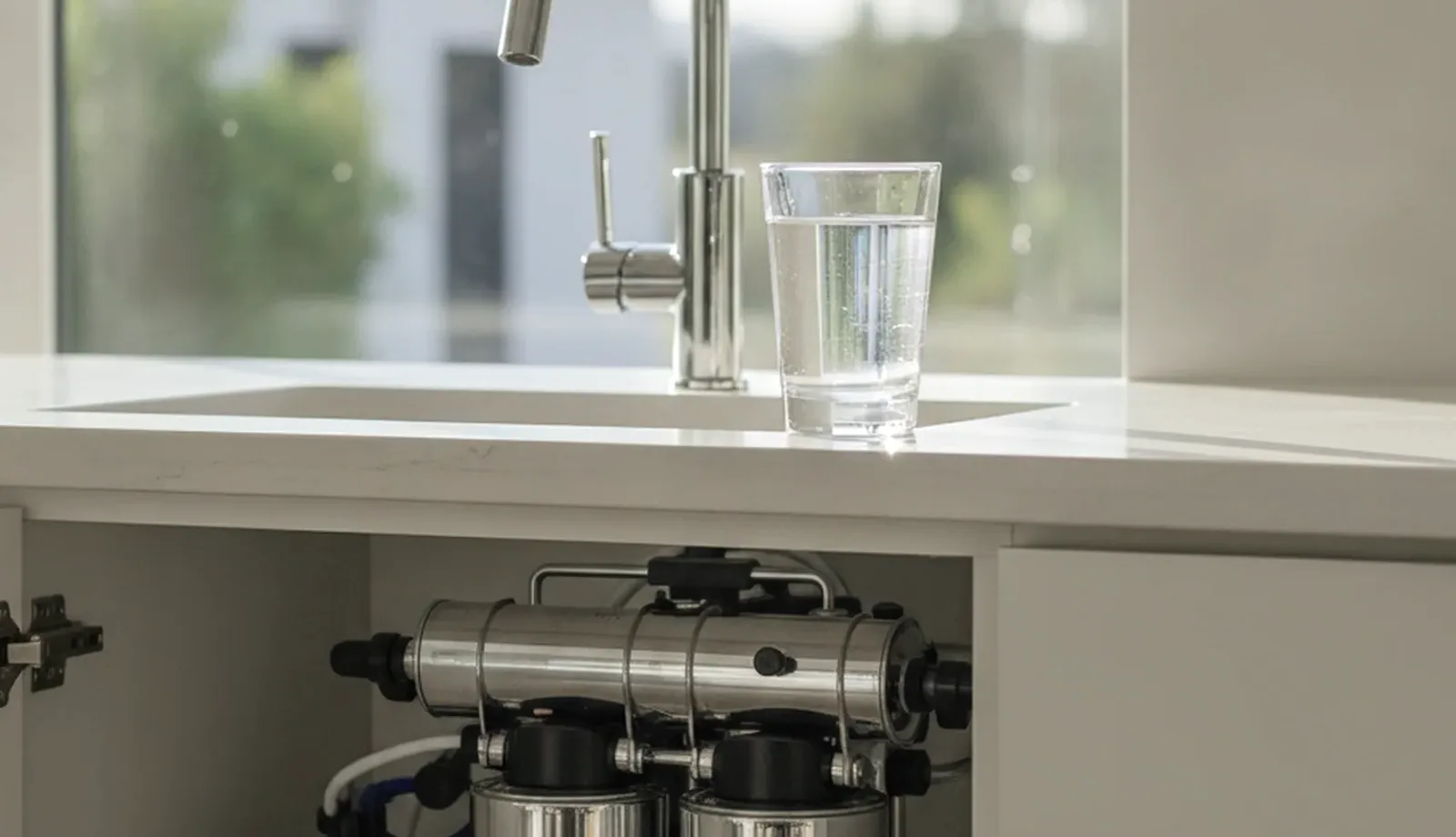
Treating just the kitchen sink often makes more sense for cooking water. Treating every fixture in the house costs much more. Our comparison of reverse osmosis versus filter pitchers highlights ownership differences. The under-sink filtration service page explains how these point-of-use units work. For broader needs, exploring whole-house water filtration options is another path.
Limits of home treatment claims
A fluoride reduction claim does not cover every other substance. Certification for one mineral does not mean universal purification. Neglected equipment or poor installation changes the output entirely. Source water conditions and household pressure affect daily operation. Cartridge age and membrane condition matter just as much. Questions regarding personal dental care require a licensed clinician. Dentists consider individual situations alongside utility fluoride information. Discussing infant formula preparation also requires professional medical guidance. An independent specialist can evaluate your home setup properly. Residents in La Jolla follow this exact same process. Understanding reverse osmosis cost factors helps when comparing models. Exploring reverse osmosis drinking water systems gives you more background before deciding.
Frequently asked questions
Do all San Diego County utilities add the same amount?
No single number describes every agency in the region. The Water Authority explains that fully treated, blended, and untreated supplies differ. Check the specific retail provider serving your address.
Will a reverse osmosis unit remove fluoride?
Some models do accomplish this. The CDC notes these systems may reduce it. NSF/ANSI 58 includes an optional claim for this purpose. Verify the exact model holds that specific certification.
Can a water softener handle fluoride?
Do not assume fluoride performance based on the product type. Softeners primarily target calcium and magnesium hardness minerals. Check the label for any additional certified reduction claims.
Does a basic field screen give exact fluoride numbers?
Only if the provider explicitly offers a formal fluoride analysis. General field screening should never substitute for laboratory results. Rely on the utility report for system-level data.
Getting professional help with your water
A separately licensed professional should evaluate your home plumbing. They can determine if treatment equipment fits your specific situation. Clear Water Pros SD connects homeowners with independent experts across San Diego County. Call (858) 400-4647 and Clear Water Pros SD will connect you with an independent local water-treatment professional.