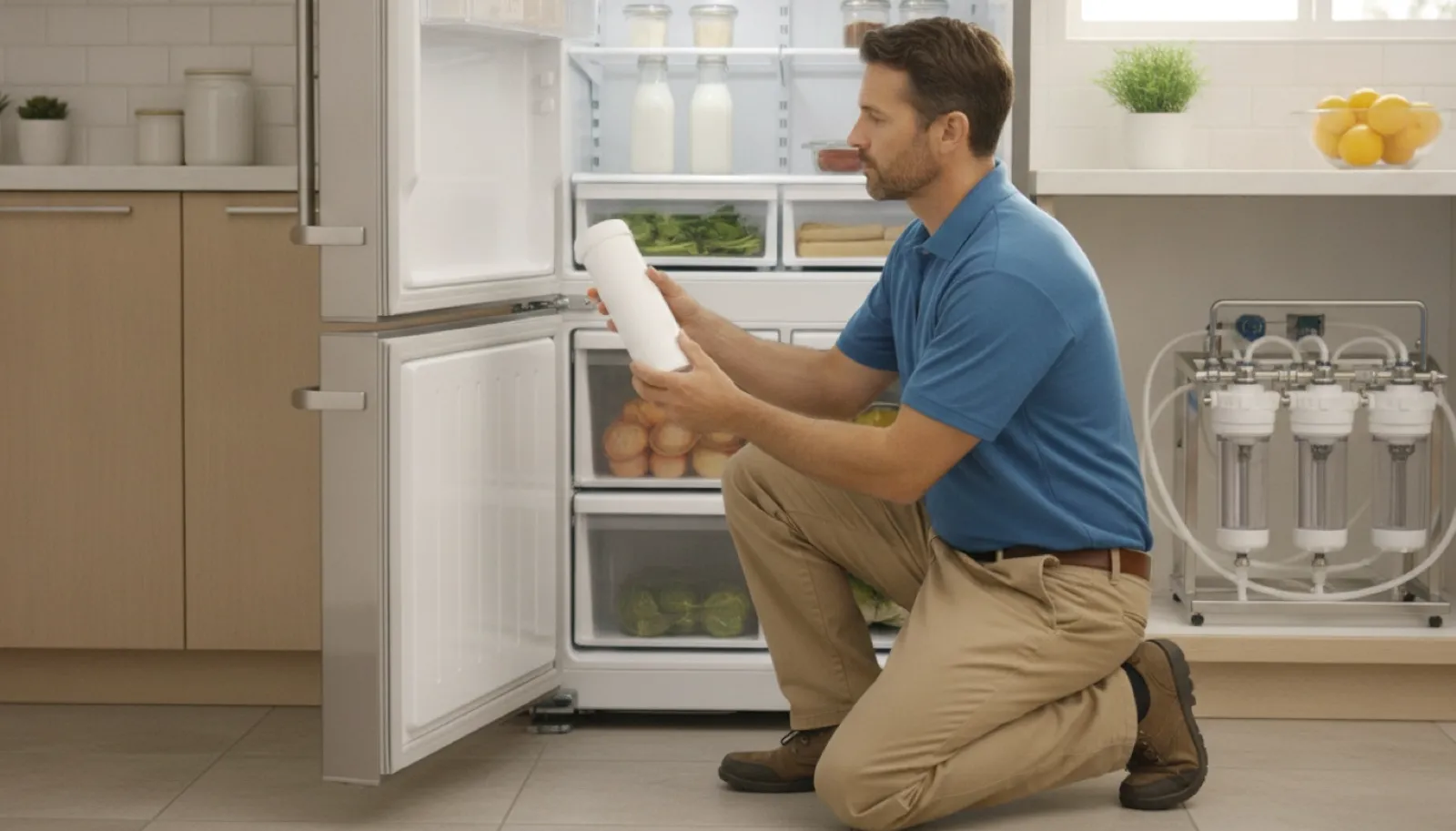
The tiny cartridge hiding inside your fridge has one main job. It makes cold drinking water taste a bit better. Many homeowners across San Diego County assume this small part handles everything. That assumption leads to disappointment when ice turns cloudy or faucets build up scale. A fridge filter is not a full treatment solution for local tap water. It only targets a narrow slice of aesthetic issues.
What happens inside that small carbon block
Water flows through activated carbon before reaching your glass or ice tray. The carbon traps certain compounds responsible for odd tastes and smells. Most units focus entirely on reducing chlorine flavor and minor particles. Manufacturers print their exact claims on the packaging certification table. Marketing slogans on the front panel mean very little without proof. You must look at the specific standard listed by the maker.
Local utilities rely on chloramine rather than plain chlorine for disinfection. Chloramine behaves differently than regular chlorine inside a filter bed. A tiny cartridge gives water only seconds of contact time. That brief window barely dulls the chemical edge of treated municipal supply. Understanding how chlorine and chloramine differ in San Diego water helps explain why fridge filters struggle here. Counterfeit cartridges sold on marketplace sites add another layer of risk. Fake parts carry zero independent verification and do nothing for your water quality. Always purchase original manufacturer replacements or check listings directly with NSF.
Limits of carbon cartridges for local water
San Diego County residents typically care about three specific water issues. Those issues are mineral hardness, total dissolved solids, and PFAS chemicals. A refrigerator cartridge addresses none of them effectively.
Mineral content remains completely unchanged after passing through activated carbon. The U.S. Geological Survey classifies our regional supply as very hard. Calcium and magnesium flow straight into your ice maker without any reduction. This explains why dispenser nozzles quickly develop a chalky white buildup. Cloudy ice cubes are another direct result of untreated local minerals. Getting the full picture requires reading about whether is San Diego water hard? before buying any equipment. Fixing mineral problems requires dedicated softening or conditioning hardware instead.
Total dissolved solids also stay exactly where they started. Anyone using a TDS meter will see identical readings before and after filtration. Membrane technology like reverse osmosis drinking water systems actually lowers those numbers. Small carbon blocks simply lack the physical mechanism to reject dissolved salts.
PFAS reduction represents another common misconception among buyers. Very few refrigerator models hold certification for PFOA or PFOS removal. Only specific units display a verified reduction claim on their spec sheet. Local agencies monitor these synthetic chemicals and report low concentrations currently. Homeowners wanting verified reduction should review information on PFAS in San Diego drinking water. Proper treatment requires specialized media designed specifically for that task. A certified PFAS removal system handles what a fridge cartridge cannot touch.
Comparing yearly expenses and actual results
Original manufacturer cartridges typically retail between $40 and $70 each. Makers recommend swapping them out every six months without fail. That schedule translates to roughly $80 to $140 spent annually. Many families find that number surprisingly high for basic taste improvement. Other treatment options often cost a similar amount over time while delivering far more.
| Treatment choice | Initial expense | Annual filter expense | Result provided |
|---|---|---|---|
| Refrigerator cartridge | $0 (already built in) | $80 to $140 | Improved taste at one single spot |
| Under sink reverse osmosis | $300 to $900 installed | $60 to $150 | Low TDS and reduced PFAS at sink |
| Whole house filtration | Varies by configuration | Varies by configuration | Treated water delivered everywhere |
Looking ahead five years changes the financial perspective significantly. Replacing fridge cartridges costs between $400 and $700 over that span. That money buys nothing beyond slightly better tasting cold drinks. An under sink reverse osmosis system often totals just a few hundred dollars more over five years. It actively strips out dissolved solids and targeted contaminants during that period. Many households eventually route purified water from the sink unit upward. This plumbing adjustment feeds the ice maker with properly treated water too.
Deciding if you need treatment beyond the fridge
A built in cartridge works fine if taste is your only complaint. Several common household symptoms point toward bigger underlying water issues. Spotting those signs early saves money and prevents unnecessary purchases.
White crust forming around fixtures indicates elevated calcium and magnesium levels. Spotted glassware coming out of the dishwasher tells the same story. These signs demand attention from hard water solutions rather than another carbon cartridge. Families seeking genuinely pure drinking water need membrane separation technology. Installing reverse osmosis drinking water at the kitchen sink accomplishes that goal reliably. Chemical odors present at every faucet require broader intervention. Addressing that problem means looking into whole house water filtration for the entire property. Guessing about water chemistry usually leads to wasted money on wrong equipment. Testing first provides clarity before anyone commits to purchasing hardware.
Clear Water Pros SD connects homeowners with independent licensed professionals who start with a free in home water test. Knowing your exact mineral count prevents buying unnecessary or undersized gear. This referral network covers all neighborhoods throughout San Diego County. Residents from Oceanside down to southern border towns can request help easily. Independent contractors evaluate your actual conditions without pushing unneeded products.
Frequently asked questions
Can my fridge filter reduce PFAS chemicals?
Most available models cannot address these synthetic compounds at all. Standard certifications cover only basic taste and odor improvements. A very small number of original cartridges show verified PFOA or PFOS claims. You must read the specific documentation for your exact model number. Dedicated treatment equipment provides reliable and tested reduction for these chemicals.
Will a refrigerator cartridge fix my hard water?
Carbon media ignores dissolved calcium and magnesium completely. Municipal supply arrives with high mineral content across San Diego County. Your ice maker receives the exact same hardness as your garden hose. Softening or conditioning equipment handles those specific dissolved minerals instead. Expect cloudy ice and crusty nozzles if you rely solely on a fridge.
When should I swap out my refrigerator cartridge?
Manufacturers generally suggest a new unit every six months. Heavy mineral loads in local water make stretching that timeline risky. Clogged carbon slows down flow to both the dispenser and ice maker. Warning lights on the appliance indicate the media is already exhausted. Reduced water pressure at the glass is another clear sign of failure.
How does filtered fridge water compare to reverse osmosis?
The difference shows up immediately when measured with testing equipment. Carbon leaves total dissolved solids almost exactly where they started. Membrane systems strip out the vast majority of those dissolved impurities. Fridge water tastes better but retains nearly all its original mineral load. Many homeowners plumb purified sink water directly into their refrigerator lines.
Does activated carbon handle local chloramine well?
It reduces the taste slightly but cannot remove it fully. Municipal suppliers use chloramine because it persists longer in pipes. Breaking it down requires extended contact time with specialized catalytic carbon. Tiny fridge cartridges rush water past the media far too quickly. Proper elimination needs larger tanks found in chlorine and chloramine removal systems.
Getting the right help for your home
A separately licensed professional should evaluate your plumbing whenever tests reveal high hardness or unwanted contaminants. Clear Water Pros SD is a referral network connecting homeowners with independent local water treatment experts who perform all actual work. Call (858) 400-4647 and Clear Water Pros SD will connect you with an independent local water-treatment professional.